
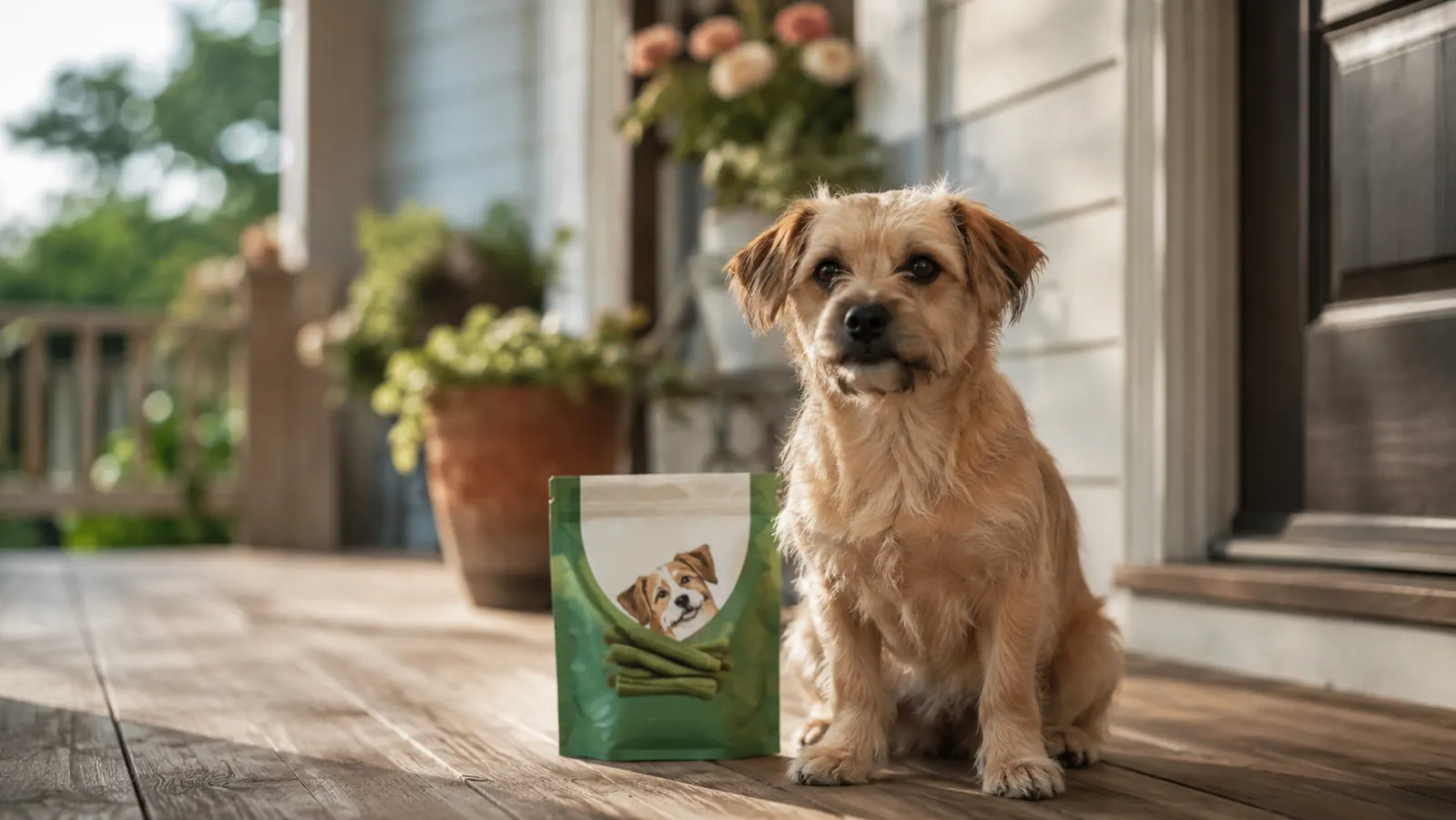
My little dog Tilly turned nine last March, and that is the age when the vet stops being gentle about teeth. At her checkup he held up a mirror and showed me the brown line creeping up her back molars, then gave me the estimate for a cleaning under anesthesia. It was a number that made me sit back in the chair. I walked out with a bottle of rinse I knew she would never hold still for, and I felt like I had failed her on the one thing I could have been doing all along.
I am not a person who is good at brushing a squirming nine-pound dog's teeth. I tried, and we both hated it, and it never lasted a week. So when the vet mentioned dental treats that carry the Veterinary Oral Health Council seal, I did not need much convincing. What I needed was something Tilly would actually chew every single day, because the whole idea only works if you stick with it. Six months later, here is what actually happened.
The Quick Verdict
A genuine everyday solution for a small dog whose teeth you cannot brush, as long as you treat it as one part of the job, not the whole job.
Amazon Check Today's Price →If your vet just showed you a brown line like mine did, this is the habit to start today
One Teenie Greenies chew a day, in a chicken flavor my picky dog has never turned down, is what finally got us into a routine that stuck. See the current price on Amazon before you decide.
Amazon Check Today's Price on Amazon →What I Tried Before the Treats
I want to be honest about how I got here, because I think a lot of you are where I was. I tried the finger brush with the little rubber nub, and Tilly bit it. I tried the flavored toothpaste, and she smelled it and walked away. I tried the chamois cloth you wrap around your finger and rub on their teeth, and she gave me a look that said plainly we were not doing this again. I read every article about dental rinses and dental wipes, and each one assumed a cooperation I did not have.
I am telling you all that because the single biggest reason a dental routine fails is not the product. It is that nobody, human or dog, will keep it up past the third day. The answer for me had to be something that fit the life I actually have. Not the life where I gently brush Tilly's teeth every morning with a soft-bristled brush. The life where she gets one treat after dinner and is happy about it.
How I've Used It
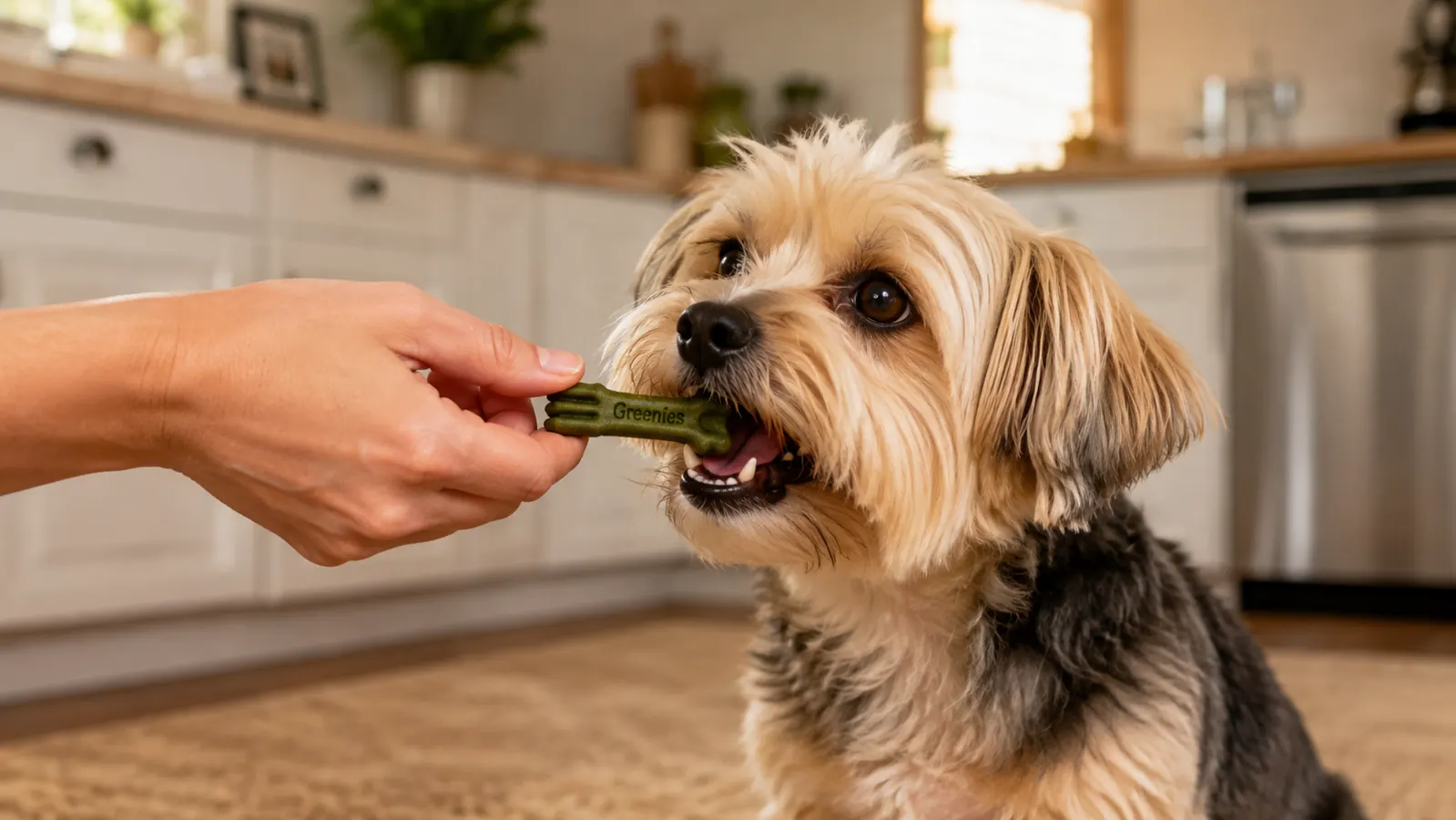
Tilly is a 9-pound terrier mix, all teeth and opinions. I chose the Teenie size, which Greenies makes for dogs in the 5 to 15 pound range. The count is 130 chews to a bag, so it lasts me just over four months, and the routine could not be simpler. Every night after dinner I hand her one, she trots over to her spot on the rug, chews it for a couple of minutes, and that is it.
The chew is green, a little firm but not rock hard, and it does the thing dental treats are supposed to do. Air pockets in it scrape against the teeth as the dog gnaws, which is a mechanical kind of cleaning. It is not a magic wand. It is a scrub, applied daily, in a form a dog will actually sit still for. That is the whole mechanism, and it is honest about what it can and cannot do.
I noted the date on the calendar the first night, May 3rd, because I wanted to be able to answer the question everyone asks: did it actually work? I also kept the vet's words in mind. He never promised the treats would erase what was already there. He said they are best at what comes after, at keeping new tartar from building up. So I went in with realistic expectations, and I think that matters a lot in whether you feel like it helped.
The one thing I would tell anyone starting: give it a full month before you judge it. The brand says it takes about 28 days for most dogs to show visible cleaning. I did not see night and day at week one. I saw it most clearly around the six week mark, when the line on her back molars started to look less angry and her breath stopped being something I noticed across the room.
What the 28-Day Claim Really Means
Greenies puts the 28 days right on the bag, and it is the claim I wanted to test honestly. Here is what I saw. The most dramatic change was not the stain on her teeth. It was her breath. Within a few weeks the smell that used to greet me when she yawned was mostly gone, and that alone made the whole experiment feel worth it to me.
On the teeth themselves, the change was slower and quieter. The brown line did not vanish. It backed off, especially along the gumline where the treat's fibers reach when the dog chews the way she is supposed to. Tilly chews on both sides, the way dogs do when the treat is the right firmness. With a softer treat she would swallow it in three bites and get nothing. The firmness here is what forces the chewing, and the chewing is what does the cleaning.
I want to be plain about the limit, because nobody said it to me and I had to learn it. A dental treat cleans the surfaces it can reach, which is mostly the outside of the teeth and along the gumline. It cannot get into the tight spots between teeth the way floss would, and no treat replaces the deep cleaning a vet does under anesthesia. If your dog already has heavy tartar or gum disease, a treat is not the fix. That is a conversation for your vet, and I was glad I had mine before I bought anything.
The most dramatic change was not the stain on her teeth. It was her breath. Within a few weeks the smell that used to greet me when she yawned was mostly gone.
What Six Months Cost and How I Feel About It
Money matters to me, and I am not going to pretend treats are free. The 130-count bag works out to a few cents a day for Tilly. Over six months that adds up, and it is an ongoing habit, not a one-time purchase. I kept the empty bags to be able to tell you this straight.
Here is my honest math. A professional dental cleaning without any extras ran into the hundreds of dollars at my vet, and that is not a one-time number either. Teeth need care for the whole life of the dog. I cannot tell you the treats will let you skip cleanings forever, because I have not been doing this long enough and because no treat honestly can. What I can tell you is this: the daily habit is cheaper than I expected, and the amount of plaque it held back in six months is visible to the naked eye.
I also checked the calories, because Tilly is a small dog and a treat is a real part of her daily food. Each Teenie is low calorie, and I took it out of her daily allowance rather than adding it on top. That is the part nobody on the packaging dwells on, but it matters for a nine-pound dog who gains weight on a hard look. If you feed a full treat every day, count it as part of the day's food.
What Tilly Actually Thinks of Them
A review from me means half the equation is the dog, and Tilly is a notoriously picky eater. She has left more treats in her bowl than she has eaten in her life. Blueberries, no. Most peanut butter, no. Greenies are the one treat I have found that she does not merely tolerate but waits for. She hears me open the bag and appears in the kitchen as if summoned, which for a dog who ignores the dinner bell is its own kind of endorsement.
The chicken flavor is what I buy, and it has a smell that is not overpowering to me but is clearly attractive to her. The texture gives her a good two or three minutes of work, which for her size is plenty. If she were still a puppy I would watch her the first few times to make sure she chews instead of gulping, because the instructions say not to let a dog swallow a chew whole. With an adult terrier who has always chewed her food, I have not had a problem, but the warning is a real one and worth heeding for a first-time buyer.

The Tradeoffs I'd Want Someone to Tell Me
No product is all good, and I would not be doing you a favor to pretend otherwise. The first tradeoff is the price. This is not the cheapest dental treat on the shelf, and if you have a big dog who needs the large size, the cost climbs a lot faster than mine does. For a 70-pound dog the daily chew costs more than twice what Tilly's does, and that is a real thing to weigh before you commit to an everyday habit.
The second tradeoff is that it is a treat, and treats are food, and some dogs have sensitive stomachs. Tilly handled them fine from the start, but I introduced them slowly and I would tell anyone else to do the same. One chew, see how the next day goes, then build up. I also kept her on the Teenie size instead of sizing up, because a chew that is too big is more likely to end up swallowed whole or broken into sharp pieces.
What I Liked
- Carries the Veterinary Oral Health Council seal, so I knew a real standard was behind it
- My picky terrier actually chews it every single day, which is the whole ballgame
- Visible results on breath in weeks and on the gumline by about six weeks
- Affordable day to day, even for a small dog, cheaper than I expected
- Simple, no gear, no brushing fights, no wrestling match
Where It Falls Short
- It is a daily habit cost, not a one-time buy, and big-dog sizes cost much more
- It cleans the surfaces a chew can reach, not between teeth, and never replaces a vet cleaning
- Some dogs with sensitive stomachs need a slow introduction
- A treat counts toward daily calories on a small dog who gains weight easily
How It Fits With the Rest of What I Do
I do not want you to read this and think a treat is all my dog gets, so let me lay out the whole picture. The Greenies are the daily habit, the part that sticks because the dog loves it. On top of that, I add a couple of dental chews a week from a different brand so the routine does not get boring, and I try to give her something crunchy in her diet that is not a treat. None of that is fancy. It is just a few small habits layered together, the way I think most good dog care actually works.
I also still go to the vet for the annual checkup, and I do not pretend the treats replace that visit. What the treats do is buy her better odds between visits. If you want to read more about how the pieces fit together, I laid out the full everyday approach in my guide to cleaning a dog's teeth without a brush, and I compared these directly against the other big brand in my Greenies versus Dentastix piece. Between the three of them you can see the whole picture, not just the one product.
Who This Is For
Buy Greenies if you are in the same boat I was: you know the teeth need something, but brushing never sticks. They are for the owner of a dog who will not hold still for a brush, and for the dog who loves a chew. They make the most sense as a daily prevention tool, started while the teeth are still in decent shape, and they are at their best on small to medium dogs where one treat a day is an affordable habit you can actually keep up.
Who Should Skip It
Skip them if your dog already has heavy tartar, red gums, or any sign of dental disease, because no treat is going to fix that and waiting only makes the vet bill worse. Skip them too if you have the patience and the cooperative dog to actually brush, because brushing is still the gold standard and nothing over the counter has ever changed that. And if your dog gulps treats whole instead of chewing, or has a stomach that reacts to a new food at the drop of a hat, talk it over with your vet before you add a daily chew.
Six months in, this is the one habit we have actually kept
After a year of failed brushing attempts, the single treat our vet approved of is the one thing still in our rotation. If you have a small dog and a toothbrush you cannot win a fight with, this is where I would start.
Amazon Check Today's Price on Amazon →