

Every vet visit ends the same way. My vet looks at me over Biscuit's head and asks the same question: are you brushing her teeth? And I give the same answer I always do: I try. That is a polite way of saying I gave up years ago. Biscuit, the ten-pound terrier mix I have raised since she was eight weeks old, turns a toothbrush into a wrestling match the second it comes anywhere near her mouth. I have tried the long-handled brushes, the finger brushes, the mint paste, the chicken-flavored paste, every one that promises the dog will love it. None of them made Biscuit love it. She just got better at escaping. Then my vet handed me a box of Greenies and told me to stop fighting her and let the chewing do the work. That, not the brush, is what finally stuck.
Here is the part nobody likes to say out loud. Most dogs will never sit still for a real brushing, and most of us will not manage it daily no matter how good our intentions are. So I am not going to shame you for it. I stopped pretending I would be the exception. Instead, when Biscuit's breath turned and the estimate for a dental cleaning came back higher than I wanted to pay, I made a different plan. I sat down, found every safe way to clean a dog's teeth without a brush, and tried them on a stubborn ten-pound terrier who fights anything near her mouth. The backbone of the whole routine, and the piece that did the most good, was one nightly Greenies dental treat. If you only take one thing from this guide, start there.
Skip the wrestling match. Start with a treat that does the brushing for her.
The nightly anchor of my whole routine is a single Greenies Teenie chew. The chewing scrapes plaque off the teeth the way a brush does, and most dogs pester you for it instead of running from it. It is the only dental treat I have trusted for the past three years.
Amazon Check Today's Price on Amazon →Step 1: Look in her mouth and know what healthy looks like
Before you spend a dollar on anything, spend five minutes looking at your dog's teeth. This matters more than any product you can buy, because you cannot clean what you cannot see, and you will not know what is normal unless you look first. Sit somewhere bright, lift her lip gently, and take a real look at the same time every day for a week. Get her used to you touching her mouth before you ever try to clean it. Biscuit still does not love it, but she tolerates it now because she knows it is not the prelude to a fight.
A healthy mouth has teeth that look smooth and creamy white at the gumline, not yellow or brown at the base. Gums should be a pale, healthy pink, not dark red or bleeding when you touch them. The breath will never smell like roses, but it should not smell like something died in there. If you see dark tartar built up along the gumline, gums bleeding easily, or a smell that makes you step back, that is the point to call your vet instead of trying to fix it at home. Those are signs you need a professional cleaning, not a new treat. Knowing the difference up front kept me from wasting money on the wrong solution.
Step 2: Make one daily Greenies dental chew the backbone of your routine
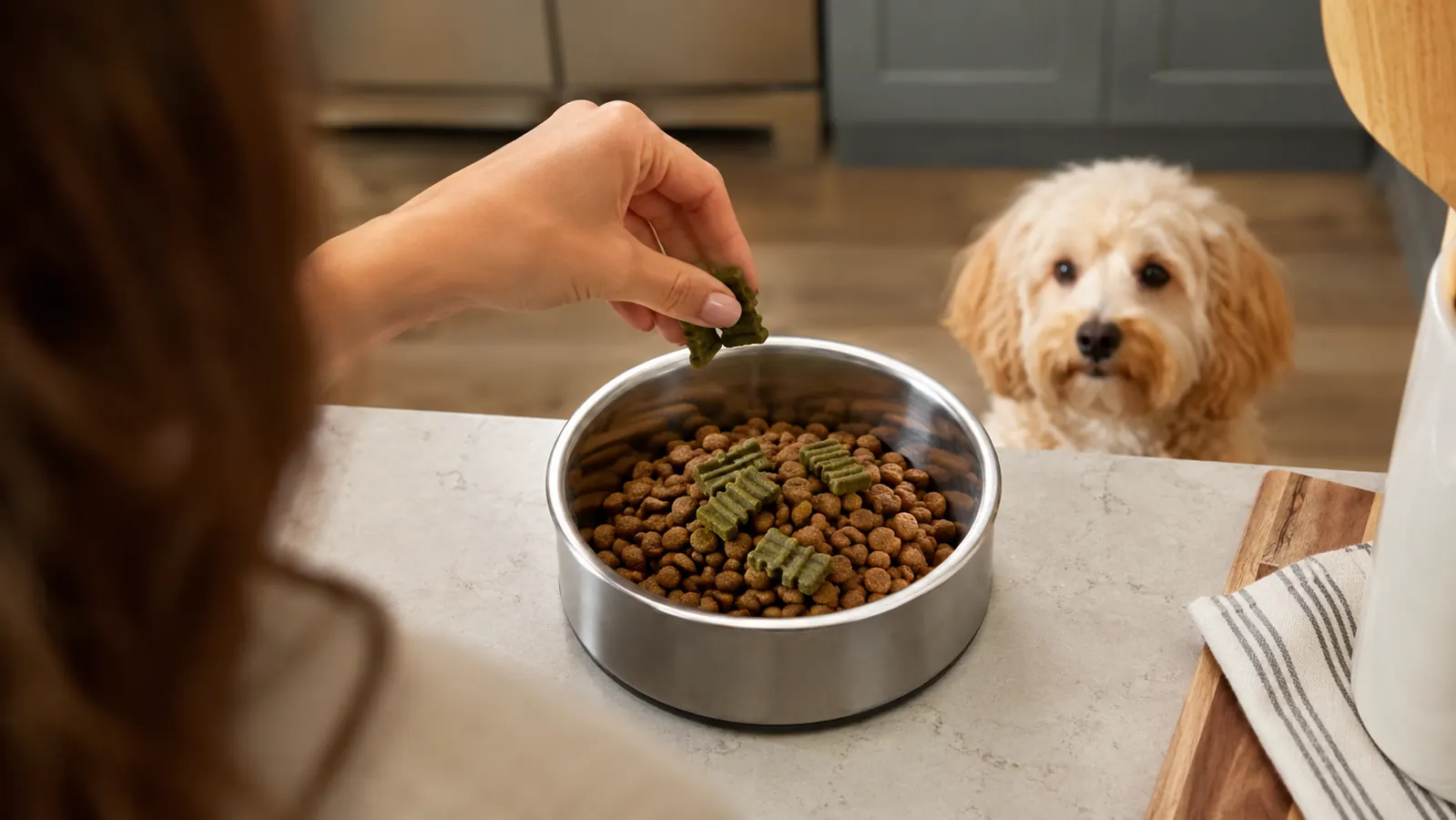
This is the step that did the heavy lifting for me, and the one I recommend to anyone who asks. Every night after dinner, Biscuit gets one Greenies Teenie treat. The bark-like texture is rougher than it looks, and the whole point is the chewing. As she works the treat, it rubs against the sides of her teeth the way a brush bristle does, loosening plaque and scraping it off before it hardens into tartar. She cannot inhale it in one bite, so she has to actually chew, and that chewing is what does the cleaning.
Greenies are what my vet recommended first, and they are the one dental treat I have seen her stand behind through all the years I have been taking Biscuit in. The Teenie size is built for dogs under about fifteen pounds, which is why it fits Biscuit, a ten-pound terrier, perfectly. Pick the size that matches your dog's weight, and make the chew its own small event at the same time each day. Biscuit knows the routine now. She sits, she chews, and it takes her a good ten minutes to finish one. That is ten minutes of scraping happening that used to turn into a wrestling match.
I will be honest about the money side of it, because I know what a dental cleaning costs and I know nobody wants to add another regular expense. The Greenies Teenie box holds one hundred thirty treats, and at one a night that is over four months of daily dental care from a single box. When I laid that out next to the price of one professional cleaning, the math was not even close. The whole point of the routine is to make the pricey visit happen far less often, and on a budget that reasoning is what sold me. A treat a night is a small amount next to an anesthetic dental procedure.
Step 3: Add a chewing surface for the back teeth a treat cannot reach
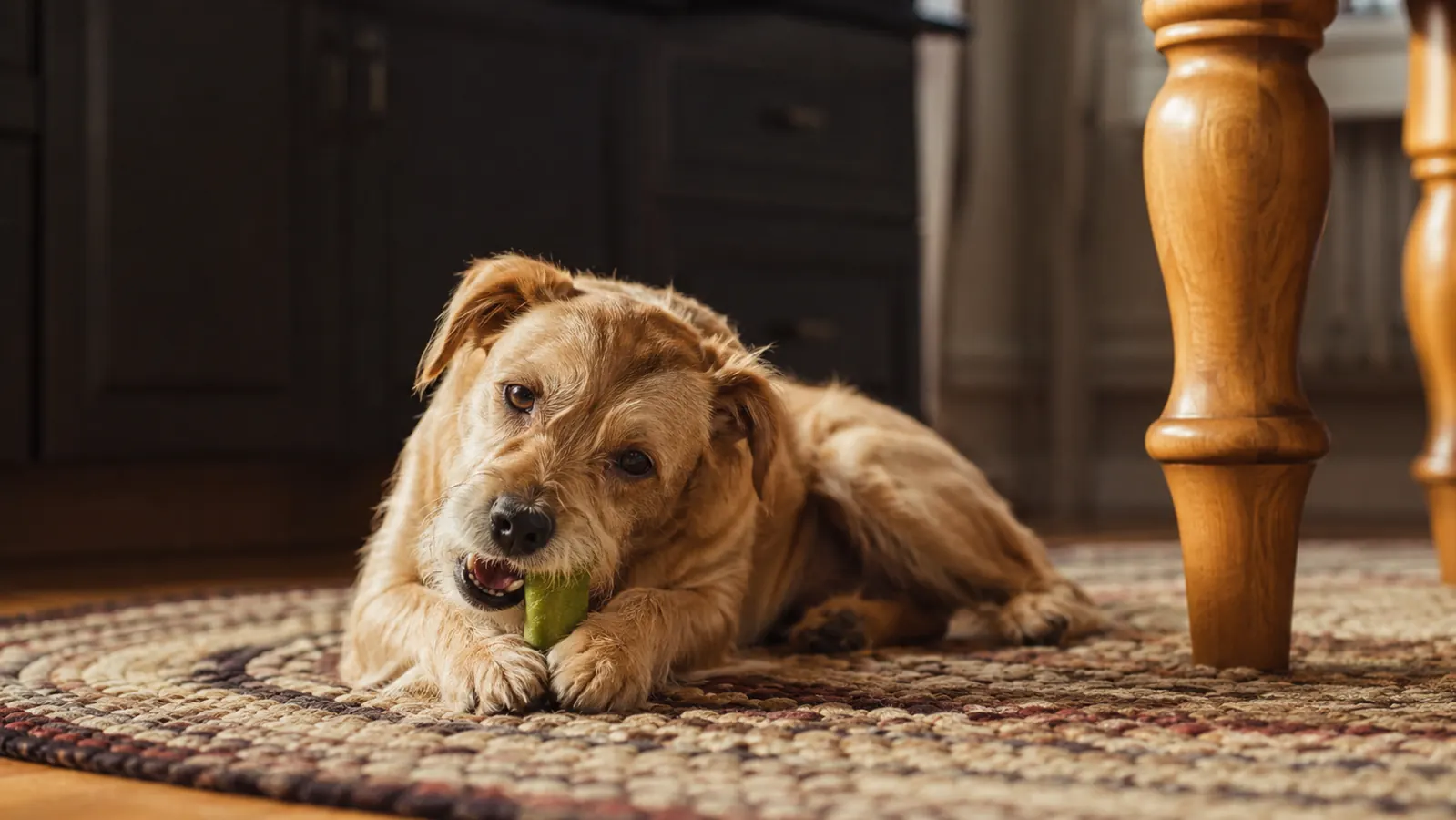
A daily treat cleans the teeth that the treat rubs against, but the very back molars do not get as much attention. That is where a second layer of the routine comes in. Give your dog something safe to chew that reaches toward the back of the mouth. A firm rubber toy with ridges, or a dental chew shaped to get between the teeth, does a lot of the same scraping work while your dog entertains herself. She thinks she is getting a toy. Her back teeth are getting a workout.
The moment I add the chew on top of a chew session is when I notice the difference. Several minutes of chewing on a textured toy, followed by the dental treat, covers the whole mouth without me touching it. Pick a chew that is sized for your dog so she cannot swallow it, and always watch her the first few times to make sure she chews instead of trying to gulp it down. Not every dog chews the same way, so what is safe for Biscuit may not be for a hard gulper. Use your judgment and your eyes.
I rotate two or three different textures through the week rather than using the same toy every night. Some nights she gets a knobby rubber bone, other nights a chew, and the variety keeps her interested, which means she chews longer, which means more scraping. A dog who is bored of the same toy stops giving it any real effort after a few weeks. Keeping the rotation fresh is the small trick that kept the whole back-of-mouth layer of the routine from going stale.
Step 4: Try a no-brush wipe or rinse for the parts you can reach
If your dog will let you near her mouth at all, a soft finger wipe or a dental rinse adds a little more without a brush. A finger wipe is exactly what it sounds like, a soft cloth you slide over your finger and rub along the teeth. It is gentler and less scary than a handled brush, and a lot of dogs tolerate it because it feels more like being petted. I keep one by the couch and do a quick pass on Biscuit's front teeth a few nights a week when she is sleepy and relaxed.
A water additive or dental rinse goes in the bowl and works as your dog drinks, which is the easiest option of all for a dog who will not let you near her mouth. I did not see as dramatic a result from the rinse as I did from the chew, and I would not rely on it alone, but I do think it helped round out the routine. If your dog will drink the treated water, that is free effort with very little fuss. Just check the label for a safe dosage and make sure she is actually drinking enough.
Step 5: Keep the routine regular and know when to call the vet
None of this works if it only happens when you remember. Dogs do best on a steady routine, and so do their mouths. The daily chew at the same time each night, a chew session a few times a week, a wipe when she will sit still, all of it adds up over weeks and months. This is a slow, steady approach, not an overnight fix. Give it a full month before you judge it, because plaque does not disappear in a week any more than it built up in a week.
And still keep your vet in the picture. A home routine is not a substitute for a professional cleaning, it is a way to make that cleaning less necessary and less expensive over time. Biscuit still sees the vet every year, and we still talk about her teeth. What changed is that the conversation is no longer me hanging my head. Her annual visit is calmer, my wallet is lighter for it, and I no longer dread the dental question. That alone made the whole routine worth it.
What Else Helps
Beyond the steps above, a few habits round out the whole picture. A quality dental diet or crunchy kibble adds a little friction with every meal. Giving plain water instead of anything sweet keeps the mouth cleaner. And I will say it plainly, the single biggest factor in Biscuit's mouth being better is that the routine is consistent. A good chew every single day beats a perfect routine you only manage twice a month. If you want to understand why the daily Greenies treat earns its spot, I break down the exact reasons in this article on why dental treats belong in every routine.
Be realistic about the limits too. If your dog already has heavy tartar, bleeding gums, or a foul smell, no treat or wipe is going to fix that at home, and I am not going to pretend otherwise. That is a vet problem. What a home routine does is keep a healthy mouth healthy and stretch out the time between professional cleanings. For a full picture of the tradeoffs, including the calories and who should skip them entirely, my honest Greenies review covers all of that. I would rather you read the downsides before you buy than be surprised later.
One more thing I learned the hard way. Do not chase the latest expensive gadget or the slick new dental product that promises to fix everything. My kitchen table rule has always been simple: start with the basic daily chew, keep your hands steady, and talk to your vet once a year. The routine that lasts is the one that is boring enough to stick with. Papers and gadgets come and go. The nightly ten minutes of chewing that cleans her teeth, that is what has stayed for three years straight.
Biscuit's breath stopped smelling like money going out the door within about three weeks, and her gums went from a worrying red-pink to a healthy pale pink. All of it happened without me brushing her teeth a single time.
One nightly chew beat six years of wrestling matches.
The Greenies Teenie is the piece of the routine I would not drop, the one that did the real cleaning without a brush in sight. Sized for small dogs, vet recommended, and my terrier begs for it instead of running from it. That is the kind of easy I can stick with every night.
Amazon Check Today's Price on Amazon →